

 Egre
Egre

Little taster from Matt Pycroft of the shooting he did on the Longhope Route. Man that is some airy swing into space Matt! Full article is on Planetfear here.
Showing posts with label Longhope route. Show all posts
Showing posts with label Longhope route. Show all posts
Tuesday, July 12, 2011
Friday, July 8, 2011
Returning from Orkney

On Rats Stole my Toothbrush E5/6, Mucklehouse Wall
I wrote this on the way home from our trip to Orkney, having had a great time. The final days were mostly spent gathering some really cool footage for our film about the Longhope route which we’ll prepare for the autumn.

Ed Drummond revisiting St John’s Head. Photo Lukasz Warzecha
For the last few days we also had a nice visit from Ed Drummond who stayed with us and walked back in to St John’s head to see his route again, 41 years after his original ascent. We filmed his return to the climb, his perspectives on it and it’s place in his life, which were very interesting. He felt the reports of my ascent were a little unfair in describing his ascent in 1970 as an old aid route, given that apart from the complete aid pitch on the top headwall, they only used around 10-15 points of aid up to the A2 crack. Of course this was a remarkable climbing feat and in what sounds like the ethic of the day for big wall routes. It’s hard for people to imagine how hardcore it was to venture onto the world’s big walls before anyone else and without cams etc.
Nowdays, I guess things are a categorised a little more cut and dry. There is less room for caveats and details in sport. In my opinion this has it’s good and bad points. Simplicity raises the game. For example - a point of aid makes it an ‘aid route’? Yes or no? It sounds like in 1970 the answer would maybe be no but now maybe yes as the climbing game has evolved. Oliver Hill referred to my ascent of the Longhope as a rehearsed ascent. I’m totally happy with that even though I climbed 4/5 of it onsight. If I rehearsed only one move it’s still a redpoint. It has to be. There is no room to make compromise look like success with redpointing - it has to be in one push with no falls. A side effect is it makes it easier for others to quantify it later when they are not familiar with the details. More importantly, on a personal level it’s good when the finish line between success and failure is absolute, binary. You either succeeded or failed to redpoint.
Simplicity can be a bad influence when it obscures or distorts the real picture or just dumbs everything down. Even words so central to sport like “winner” and “loser” must be applied carefully. If you have been watching tennis recently they keep talking about “great champions”. But there seems to be so many great champions they need a new definition already to stand out from them. It’s not enough even to refer to them as just “champions”, never mind “players” or even “people”. Edi Stark didn’t seem to want to accept my response to her question about how it felt to have done some climbs that are out of reach of some or most others. I said it was ‘nice’ to have found such a good connection with an activity like climbing. “Nice?” she repeated back to me with a mocking sarcasm. ‘Nice’ didn’t seem to cut it. Either that or it cut me out as an awkward personality? With the exception of an overflow of enthusiasm which is a fine excuse to dispense with caution, I feel there is no need to always attach larger than life language, deeper meanings or metaphors to my experiences in climbing or elsewhere. A climb is the expression of the climber through vision for the line, preparation of the skills and movement. And it is an appreciation inherent beauty of the rock and the place as well. These things are already special in their own right. They do not need sweetening or plumping up.
Having succeeded on my own climbing vision on the Longhope route with Andy, my feeling is not of me, the climber, being at the centre of the story and I do not feel any bigger or more worthy as a result of it. Rather completing my climbing involvement on this particular cliff leaves me with a greater appreciation of the scale, permanence and impermanence of different things in nature and this has been what is awe inspiring about it. I think that climbing and mountains have a great effect on peoples lives when it helps them to appreciate their true insignificance in the world both in scale and time. Paradoxically though this actually adds to the sense of meaning in life because you simply see more clearly how you fit into the world. In the process of appreciating your insignificance, you also get closer to a true sense of your significance.
How then, do you deal with another great paradox of a major effort on a big climb; that of the feeling of invincibility that climbing can give when you are performing well and at your limit. Of course if you step back it’s obvious that the feeling cannot really be invincibility or anything approaching it. So if it’s a misinterpretation, what is the correct one? I have felt happiest in climbing when I’ve seen this feeling not as wielding personal strength or power over my climbing environment, but as aligning to it, understanding it well enough to work in harmony with it. This idea of harmony with the medium, in this case rock, is so well known that it’s a cliche. Where does the difference lie between these two subtly different interpretations of the same raw feeling. The most frustrated, isolated or bored climbers I’ve met have been those who appear to chase after brief flashes of invincibility in themselves over nature instead of seeing brief flashes of the invincibility of nature in themselves.
Sunday, June 26, 2011
Getting them in on Orkney

The soaring crack pitch of Mucklehouse Wall, E5 6a
Since completing the Longhope Direct, our trip on Orkney has been light of step but heavy of leg. The team are all feeling a tad fatigued from great efforts of rigging, filming and eating a lot of cake to replace all the calories that you seem to burn here. For me it’s been a lovely slow release and realisation that the route is done and I can wake up a little more to the sights and sounds of Hoy without the blinkering weight of focus on the project that tends to eclipse everything else.
So I’ve had a chance to squeeze in a couple of climbs in between filming the nature of the place a little more. I always felt that if I could manage to complete the route it would be really nice to make a film about it because everything about it - the scenery, nature and character of Hoy, not to mention the climb itself leaves quite an impression. Filmmaking is hard work to do well, so now the climb is done, the hard work begins again.
Myself and Guy nipped up the Old Man of Hoy the other morning before some rather more arduous filming. Andy and I also had a great evening on the 4 pitch E5 Mucklehouse Wall. You can see in the little clip below from my compact, you have to clean most of the sandy breaks as you go, and the top pitch was rather seepy but the climbing and exposure was just amazing. Once again the difference between new routing and just going cragging is massive. It’s just so much easier on the head to know that there are holds up there somewhere to go for because someone has passed before.
The nature of the movement here, and the approach to climbing generally couldn’t be more different from what I’m used to. On hard rock I’m just so used to pulling super hard on small holds. On a good bit of the sandstone here, if you are really cranking on a small hold, then you’re probably doing it wrong, or about to break the rock. It’s very steep, but you can’t really sprint - go to fast and a sandy hold will catch you off guard. A steady, confident pace yields the most reliable upward progress.
I must admit to feeling a little sleepy from a combination of fatigue from the big effort of Tuesday, and the knock on effects of teething. It’s too bad as the coming days are filled to the brim with plans of filming, rigging, derigging, climbing, and walking with heavy equipment through the sponge bogs of of the Hoy hills.

Andy Turner, new route, Rora Head

Airy traverse pitch on Mucklehouse Wall


Perfect rock on Mucklehouse pitch 4

Guy Heaton starts up the Old Man of Hoy

Hungry mouths
Wednesday, June 22, 2011
Longhope Direct

Approaching the guillotine flake before the crux pitch or the Longhope Direct. Photo: LW Images

Starting into the crux Photo: LW Images

Bringing Andy Turner up to the Guillotine belay. Photo: LW Images
The Longhope route was first climbed as an aid route by Ed Drummond and Oliver Hill in 1970. After climbing it yesterday I have a doubly renewed respect for the boldness of climbers of that period. To venture up that cliff without cams, taking the steepest line possible was a hardcore effort. They spent 7 days climbing the route, sleeping in hammocks or in the big sandstone breaks with the fulmars. Dawes and Dunne both had a look at freeing it, albeit briefly. It was the adventure trad master John Arran, and sea cliff guru Dave Turnbull who really went for the free ascent. Over two days, they freed the lower pitches with a bivi in between and then bailed off left. A few months later, they returned, abseiling from the summit of the stack to their highpoint and climbing four more pitches to the top across another two days.
But they considered Drummond’s A2 crack pitch up the centre of the overhanging headwall too hard for free climbing, which it really was given that they were climbing ground up and the pitch was going to be in the region of E10 in itself. So they climbed the big grooves to the left, traversing back in after a couple of pitches to climb the last 8 metres of the crack, which was the crux of their version which went at E7 6c after lots of tries.
Oliver Hill emailed me in 2006 pointing out that the crack pitch of the original line was still there to be freed and would make a super hard trad route that seemed like a logical progression from the single pitch E10s and E11s of the past few years. Most of the world’s hardest multipitch routes with climbing of 8b or above are essentially sport routes, protected by bolts, insitu pegs or trad with bolts wherever there isn’t good gear available. Oliver thought I should bolt the Longhope route, to make it realistic. But I wasn’t really worried about having a drawn out epic trying to climb it. My idea was to have a super hard long route that was bold, loose, birdy, hard to climb in a day - as pure as possible. That’s absolutely what Scottish sea cliff climbing is about.
So a drawn out epic was exactly what I had. Lots of driving back and forth to Orkney, many days of cleaning the headwall pitch and trying the moves and a two attempts from the ground, climbing the lower pitches on sight with Michael Tweedley and Donald King.
This time, I took the full weight of pressure and organised a proper trip with Andy Turner to climb it with, and a team to help us capture it on film and photos (Claire MacLeod, Paul Diffley, Lukasz Warzecha, Matt Pycroft, Guy Heaton and Mariam Pousa). It’s quite scary bringing a team of people to watch you fall off a large rock for two weeks. I’m super appreciative of the help that was offered from Mountain Equipment, Black Diamond, and Stoats with the trip.

The crawl traverse on pitch 2.
Climbing it in a day was the big deal for the difficulty of the route. I knew the crux pitch,65 metres long and around 8b+ish with some long runouts would feel about 90% of my limit. But could I climb the 400 odd metres below without losing 10% of the strength in my arms. When I got to the guillotine belay before the big pitch, the answer felt like most definitely NO! I was knackered. If the pitch was 8a+ or even 8b on trad, it would be fine. But I knew it was hard enough that it just wouldn’t work if I didn’t have the energy to pull down on those wee edges.
As I brought Andy up I could feel a sinking sense of failure on the route and the huge waste of opportunity. I started to wonder if the odd missed training session here and there would have made the difference? Should I not have eaten this or that? The chance to be on this route, in good conditions, with a good partner is so special. As I get older I sense more and more strongly all the time that life moves on, opportunities pass - for good. Just to have opportunity is such a gift. Wasting half chances is just not on.
With this in mind and swallowing a lot of nerves, I launched up the pitch for an all out fight with no inhibitions or hesitation. On the final crux before joining John Arran’s E7 section, All I could see was the outline of the jug above me. I grabbed it and screamed with utter relief. All that was needed was to use a bit of experience to hold it together and scrap my way through The E7 part, the final roofs and the final fulmars to the summit.
Today I’m eating cake in Stromness. Time to take Freida for a walk along the high street.
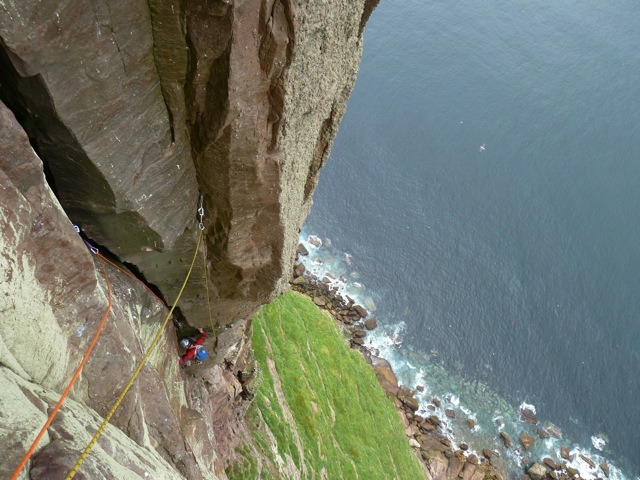
Looking down the Vile Crack pitch

Andy approaching the fulmar puke ledge ledge after pitch 1. Note the vomit splat bottom left, which went via my trousers.
More photos and video to be had on Matt Pycroft and Hot Aches pages.
Sunday, June 19, 2011
Rain, drizzle, mist, clag

Lukasz’ mobile wifi service

The team slog it

It was nice when we got here

Freida enjoyed the beach
I’m writing this post which means our trip on Orkney is not going according to plan. Just now I should be uncoiling ropes at the foot of my project. Instead we are drinking tea, watching drizzle settle on the road outside and looking at ferry times to Kirkwall.
On Hoy it seems very easy for a lot of time to pass. Day 1 was great, I had a session on the crux and felt fit and rigged about 400m of rope for the guys filming (pics on Lukasz’ blog). Yesterday I rested tired arms after that and took Freida to see the sea. Today was time to get down to business. Nevermind.
I’m not sure whether this type of this should make you highly impatient, or cleanse you of impatience? Actually I don’t mind waiting too much, even though the forecast isn’t exactly great. But a 45 board would come in handy right now.
Wednesday, June 15, 2011
North again

I’m off up tomorrow (Ha! Today actually - another late night typing…) with Claire, Freida, Andy Turner, Diff, Lukasz and others for a good trip to Orkney. We’ll either be dodging fulmars on the cliffs or dodging showers and eating Stoats bars all day back at basecamp. Fingers crossed for the former.
It’s going to be cool to go for a proper trip, so long as we get some weather of course. I’ve mostly been there with Claire or just by myself and for short trips, so I’m interested to see how things go if we can get really involved with the route this time. Claire has been filming all my work on this project for the past two summers. This year we are teaming up with Diff from Hot Aches to help us keep filming. Mountain Equipment have really helped out a lot with organising this trip too. Lukasz is coming to take pictures. I think he’ll be impressed with the cliff. As will Andy. He sounds a little apprehensive on his blog, which seems funny to me, him being a machine and all. I’m quite sure Andy is a lot stronger than the Hoy sandstone. Oh, hang on, that’s the problem isn’t it!
Stoats is supporting us on Orkney with Stoats porridge and porridge bars! I’ve been munching Stoats bars on Scottish mountains for some time and thought it would a good time to get in touch with Tony for a chat about some oats. Many a crux pitch has previously fallen to the power of a good breakfast of oats. Let’s keep up the tradition..
Right I’m off to bed, to worry.
Monday, June 6, 2011
Fresh visits to Orkney begin

St John’s Head, Hoy, Orkney. It’s pretty amazing, isn’t it? I am in the picture, but you'll probably not spot me.
I just got back from two days work on my project on Orkney with progress made. Fitness is starting to materialise at last, a finger injury is becoming less and less of a bother, and logistics are ironing out.

Cleaning a new finish
I was keen to see if it was possible to finish the route over a series of roofs right at the top of the wall. So rather than the original finish skirting out right around the roofs for an easy escape, the last pitch is a ~ 70 metre pitch of around 8b+ on the top rope. Although I don’t how it’ll feel with a rack of big camalots for such a long pitch on my harness? I had thought it was going to weigh in around 8c but a miniscule foothold discovery on the crux on this trip might just take the edge off it. It's funny how a foothold about 1mm square will probably determine the overall difficulty of a 500m climb. Pics by John Sutherland.

A long pitch, and there’s 450m of climbing to get here!

John feeling the space

Brushing steeeep rock
It turns out that I should be able to lead this final 15m section through the roofs on three small cams. Since taking a belay instead would have been on two Camalot 4s, I'm actually saving weight on the crux pitch rack by pressing on all the way to the top. Happy days.

A fine rack

1945 bomber wreckage, Cuilags

Shootin the Stromness breeze
Wednesday, June 1, 2011
Hoy on the horizon
Now after four weeks of thrashing it out on the circuits I’ve gone from zero stamina to nearly-got-stamina. It’s been almost exclusively on my board since the rain has been incessant in Scotland for the whole of May. Hence the lack of new routes to report. However, the focus has been good for me probably. My 60 move circuit is now extended to 100 moves and the rest between bouts are getting shorter every session.
Still much more work to be done, but with that under my belt and a good forecast at last it’s time to head north to Orkney and get on my project for a few days and try and remember how to trad climb.


